In today’s digital landscape, where data breaches and cyber threats are becoming increasingly sophisticated, protecting sensitive information is no longer optional—it is essential. At the heart of this protection lies Key Management, a critical component of modern cybersecurity.
What is Key Management?
Key Management refers to the process of handling cryptographic keys throughout their lifecycle. These keys are used to encrypt and decrypt data, ensuring that only authorized parties can access sensitive information.
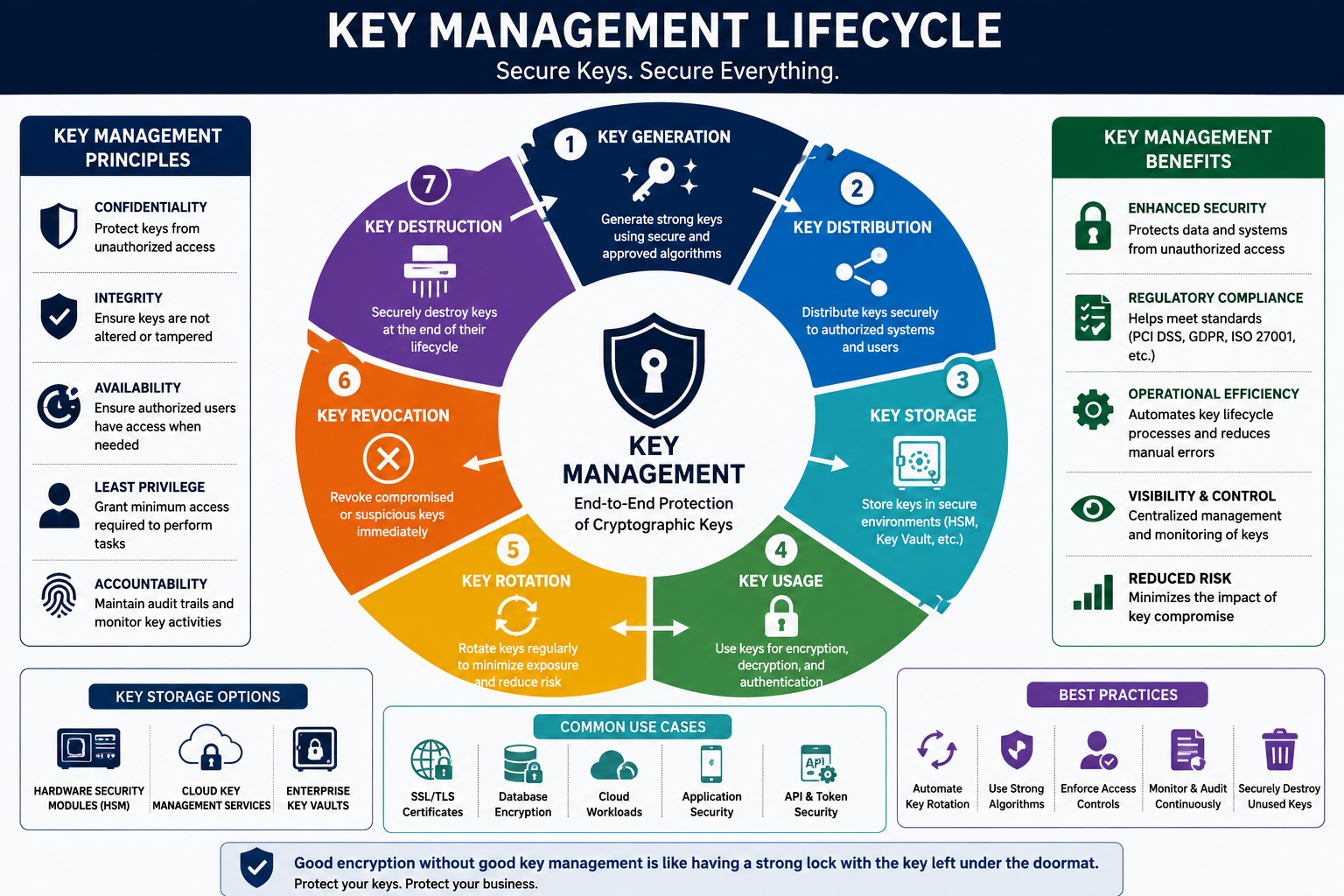
A typical key lifecycle includes:
- Key generation
- Key distribution
- Key storage
- Key rotation
- Key revocation and destruction
Without proper management, even the strongest encryption can become ineffective.
Why Key Management Matters
Encryption is only as strong as the protection of its keys. If keys are exposed, stolen, or mismanaged, attackers can easily decrypt sensitive data.
Key Management ensures:
- Confidentiality of data
- Integrity of information
- Secure access control
Core Components of Key Management
| Component | Role |
|---|---|
| Key Generation | Keys must be generated using strong cryptographic algorithms and secure random processes |
| Key Distribution | Secure channels must be used to distribute keys to authorized systems and users |
| Key Storage | Keys should be stored securely, often in:
|
| Key Usage | During operation, keys are used for encryption, decryption, and authentication. It is crucial to enforce strict policies on how and where keys can be used, ensuring only authorized entities have access. |
| Key Rotation | Regularly updating keys reduces the risk of long-term exposure |
| Key Revocation | Compromised or unused keys must be revoked immediately to prevent misuse |
| Key Destruction | At the end of its lifecycle, a key should be securely destroyed to ensure it cannot be recovered or reused |
Benefits of Effective Key Management
| Benefit | How |
|---|---|
| Enhanced Data Security | Proper key management ensures that sensitive data remains encrypted and protected from unauthorized access |
| Regulatory Compliance | Organizations can meet compliance requirements such as:
|
| Reduced Risk of Data Breaches | Even if attackers gain access to encrypted data, they cannot decrypt it without the keys |
| Centralized Control | Key management systems provide a centralized way to control and monitor all cryptographic keys |
| Improved Operational Efficiency | Automation of key lifecycle processes reduces manual errors and administrative overhead |
| Scalability in Cloud Environments | Modern key management solutions integrate seamlessly with cloud platforms, supporting dynamic and scalable architectures |
Key Management in Modern Architectures
With the rise of:
- Microservices
- APIs
- Cloud-native applications
Key management has evolved to support distributed environments. Organizations now adopt:
- Cloud Key Management Services (KMS)
- Secrets management tools
- Zero Trust security models
This ensures that keys are securely managed across multiple services and environments.
Key Management is not just a technical necessity—it is a strategic pillar of cybersecurity. As organizations continue to embrace digital transformation, the importance of securing cryptographic keys will only grow.
By implementing robust key management practices, businesses can safeguard their data, build trust with customers, and stay resilient against evolving cyber threats.