
In today’s digital world, passwords have become both a necessity and a burden. We’re constantly asked to create complex combinations of letters, numbers, and symbols—only to forget them, reuse them, or fall victim to phishing attacks. This is where passkeys come in, offering a simpler and far more secure alternative.
What is a Passkey?
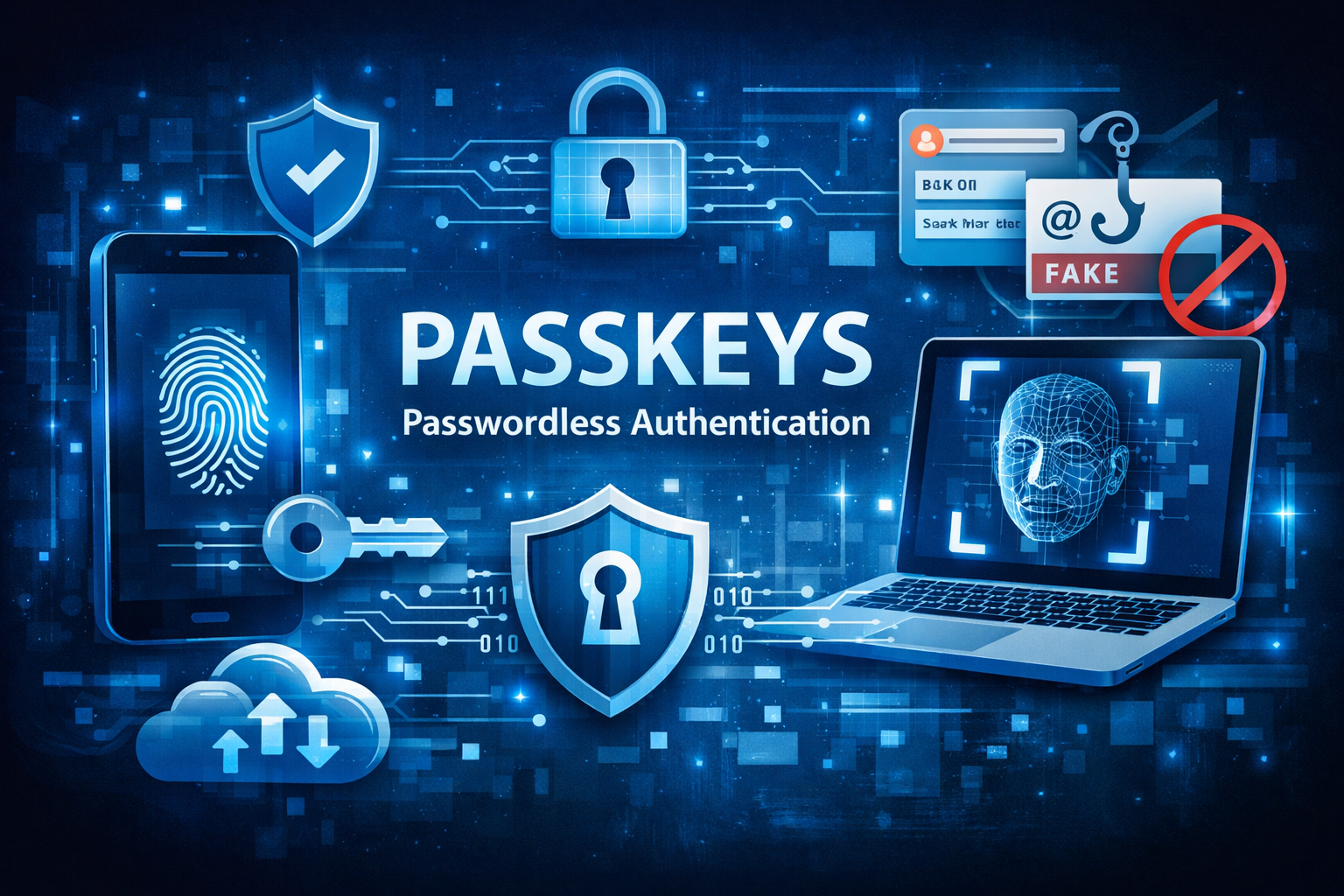
A passkey is a modern authentication method that allows users to log in to applications and websites without using traditional passwords. Instead of relying on something you remember, passkeys use something you have (your device) and something you are (biometrics like fingerprint or facial recognition).
Behind the scenes, passkeys are based on public-key cryptography:
- A
private keyis securely stored on your device. - A
public keyis stored on the server.
When you log in, your device proves it has the private key—without ever sharing it.
How Passkeys Work
The process is simple from a user perspective:
1. Registration
- You create an account or enable passkeys.
- Your device generates a key pair (public + private).
- The public key is sent to the server; the private key stays on your device.
2. Authentication
- When logging in, the server sends a challenge.
- Your device signs the challenge using the private key.
- The server verifies it using the stored public key.
3. User Verification
- You confirm your identity using biometrics or device PIN.
No passwords. No typing. No remembering.
Why Passkeys Are More Secure
Passkeys address many of the weaknesses of passwords:
1. Phishing Resistance
Passkeys are tied to specific websites and cannot be tricked into working on fake domains.
2. No Shared Secrets
Unlike passwords, the private key is never sent to the server, reducing the risk of data breaches.
3. Device-Bound Security
Your private key is stored securely on your device, often within hardware-backed secure enclaves.
4. Reduced Attack Surface
No password reuse means attackers cannot leverage leaked credentials across services.
Passkeys in Modern Architectures
Passkeys are becoming a key component in modern identity systems, especially when combined with:
- Single Sign-On (SSO) platforms
- OAuth 2.0 / OpenID Connect flows
- Identity providers and access proxies
In a typical architecture:
- The authentication layer handles passkey verification.
- Identity tokens are issued after successful authentication.
- Backend services trust these tokens instead of managing credentials.
This aligns well with zero-trust and passwordless strategies.
Challenges and Considerations
While promising, passkeys come with some considerations:
1. Device Dependency
Users need access to their registered devices. Recovery flows must be well-designed.
2. Ecosystem Support
Although widely supported, not all systems and legacy applications are ready for passkeys.
3. User Education
Users may need time to understand and trust passwordless authentication.
4. Backup & Recovery
Organizations must plan for scenarios like lost devices or account recovery.
The Road Ahead
Passkeys represent a significant shift in how we think about authentication. As adoption grows, we can expect:
- Reduced reliance on passwords entirely
- Stronger protection against phishing and credential theft
- More seamless user experiences across devices and platforms
Major platforms are already embracing passkeys, signaling a future where passwords become obsolete.