
As AI agents become more capable and autonomous, visibility into their actions is becoming just as important as the intelligence that powers them.
Over the past few years, AI has evolved from being a helpful assistant to becoming an active participant in business operations. Today, organizations are experimenting with AI agents that can make decisions, access systems, retrieve information, and even execute tasks with little to no human intervention.
It’s easy to see why businesses are excited. AI agents promise greater efficiency, faster response times, lower operational costs, and the ability to automate complex workflows that previously required human effort.
But amid all the enthusiasm, there is a growing concern that doesn’t receive nearly as much attention as model capabilities or agent performance: How do we know what these agents are actually doing?
The answer lies in observability.
The Problem Isn't Intelligence—It's Visibility
Most discussions about AI focus on how powerful the models are becoming. We hear about larger context windows, better reasoning, and increasingly autonomous agents.
What we hear less about is what happens after these agents are deployed into real business environments.
Imagine an AI agent that can approve transactions, update customer records, access internal systems, or trigger business workflows. If something goes wrong, can your team answer these questions?
- Why did the agent make that decision?
- What information did it use?
- Which systems did it access?
- What actions did it perform?
- Was it operating within approved boundaries?
For many organizations, the honest answer is “not completely.”
And that’s where the real challenge begins.
AI Agents Are Not Traditional Software
Traditional applications are generally predictable. Developers define rules, users provide inputs, and systems produce expected outputs.
AI agents behave differently.
They can interpret objectives, determine the steps needed to achieve them, select tools dynamically, and adapt their actions based on changing circumstances. This flexibility is what makes them so valuable, but it’s also what makes them harder to monitor and govern.
The more autonomy an agent has, the more important it becomes to understand its behavior.
Organizations wouldn’t allow employees to perform sensitive tasks without oversight, auditing, or access controls. AI agents should be held to the same standard.
Why Observability Matters
Observability isn’t just about collecting logs or displaying metrics on a dashboard.
In the context of agentic AI, observability means having a clear understanding of what agents are doing, why they are doing it, and whether their actions align with business policies and objectives.
Good observability allows teams to:
- Trace how decisions were made
- Monitor interactions with tools and systems
- Track access to sensitive data
- Detect unusual behavior
- Investigate incidents quickly
- Demonstrate compliance with regulations
Most importantly, it helps organizations build trust in their AI systems.
Without trust, AI adoption eventually stalls.
The Risks of Flying Blind
Many organizations are moving quickly to deploy AI agents, often because competitors are doing the same.
The danger is that governance and observability are frequently treated as future problems.
Unfortunately, these challenges tend to appear long before organizations are ready for them.
An agent may access data it shouldn’t.
A workflow may execute incorrectly.
A decision may violate compliance requirements.
A customer may receive inaccurate information.
When these situations occur, organizations need more than a vague understanding of what happened. They need a complete audit trail.
Without observability, troubleshooting becomes guesswork.
Governance Must Scale with AI
A handful of AI agents may be manageable through manual oversight.
Hundreds or thousands are not.
As organizations expand their AI initiatives, they will need centralized governance frameworks that provide visibility across the entire agent ecosystem.
This includes:
- Agent identity and access management
- Policy enforcement
- Audit logging
- Security monitoring
- Performance tracking
- Risk management
- Incident investigation
In many ways, the challenge resembles the evolution of cybersecurity. As IT environments became more complex, organizations introduced centralized security operations, monitoring tools, and governance frameworks.
Agentic AI is likely to follow a similar path.
The Next Competitive Advantage
Today, much of the conversation revolves around who can build the smartest AI agents.
Tomorrow, the differentiator may be who can manage them most effectively.
Organizations that invest early in observability and governance will likely be in a stronger position to scale AI safely and responsibly. They’ll be able to identify issues faster, meet regulatory requirements more easily, and build greater trust among employees, customers, and stakeholders.
Those that don’t may find themselves struggling to control increasingly autonomous systems operating across critical business functions.
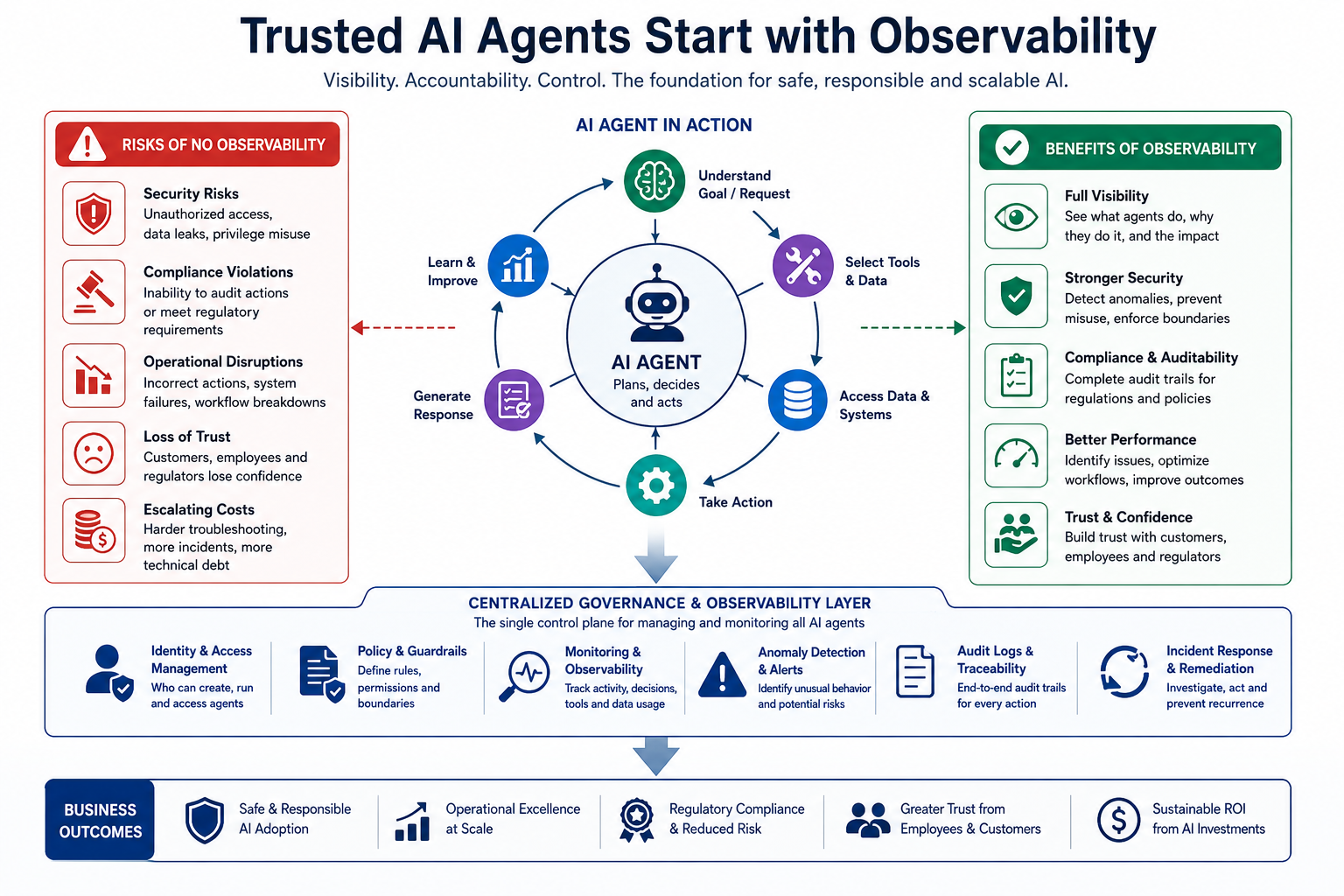
As AI agents become more autonomous, success will depend not only on their capabilities but also on how well organizations can monitor, govern, and trust them. Visibility into agent actions, accountability for decisions, and effective controls are essential to ensure AI operates safely and within defined boundaries. Just as organizations expect oversight of human employees, the same standards must apply to AI agents. In the future, observability will be a business requirement rather than a technical nice-to-have, enabling organizations to scale AI confidently and responsibly.
Observability is the ability to understand the internal state of a complex IT system by analyzing its external telemetry outputs.
AI agent is an autonomous software system that uses artificial intelligence to pursue goals and complete multi-step tasks on your behalf.