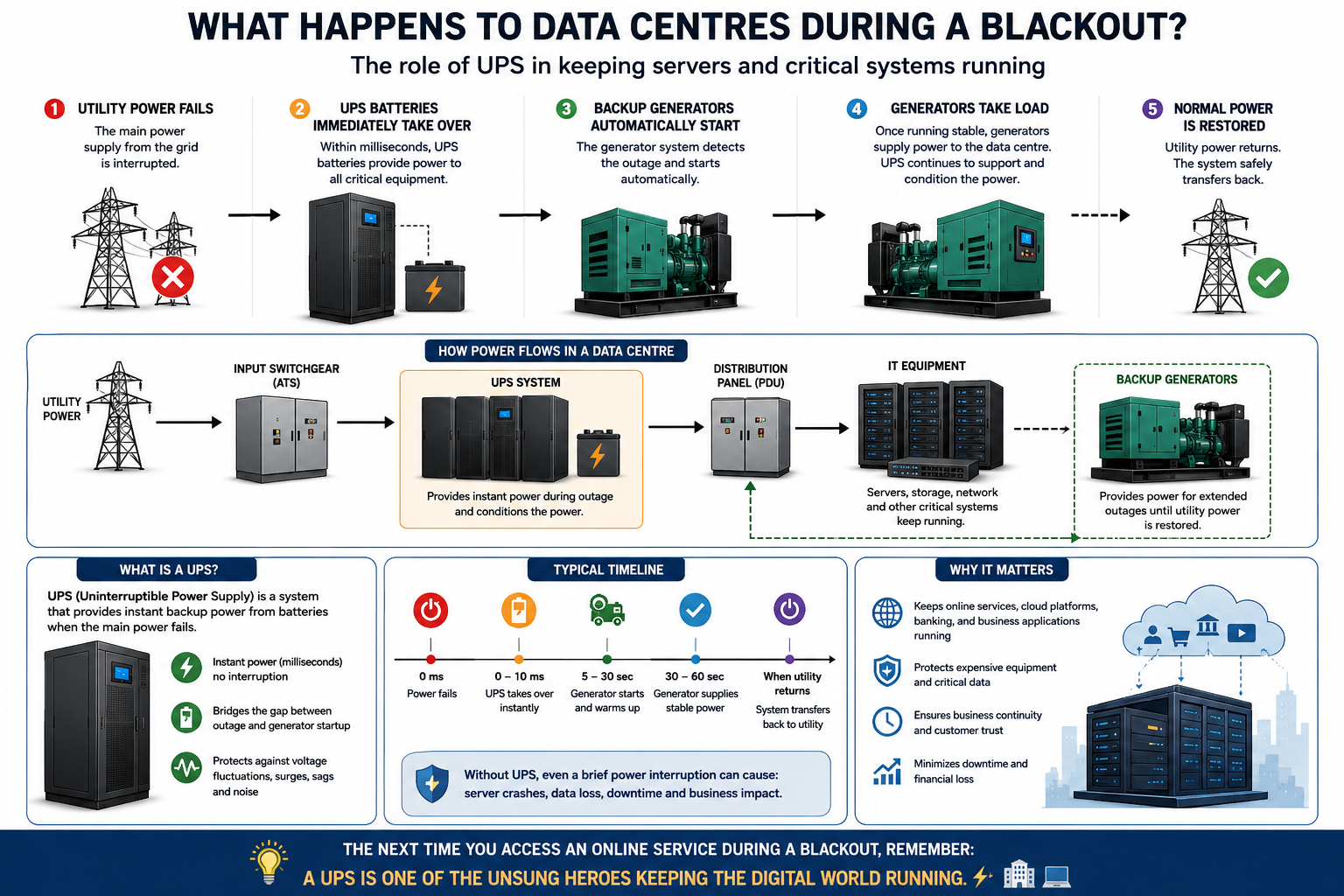
What happens to data centres when there's a blackout?
Have you ever wondered why websites, banking services, cloud platforms, and business applications continue running even when the power goes out?
The answer is UPS (Uninterruptible Power Supply).
The moment a power outage occurs, a UPS instantly supplies electricity from its batteries to keep servers, storage systems, network devices, and other critical infrastructure running. This transition happens within milliseconds, ensuring there is no interruption to services.
However, a UPS is not designed to power an entire data centre for long periods. Its primary role is to bridge the gap between the utility power failure and the startup of backup generators.
A typical sequence looks like this:
1. Utility power fails.
2. UPS batteries immediately take over.
3. Backup generators automatically start.
4. Once generators reach stable operating conditions, they begin supplying power to the data centre.
5. UPS systems continue conditioning and protecting the power supply until normal utility power is restored.
Beyond backup power, UPS systems also protect equipment from voltage fluctuations, surges, sags, and other electrical disturbances that could damage sensitive hardware.
Without UPS systems, even a brief power interruption could lead to server crashes, data corruption, service outages, and significant business impact.