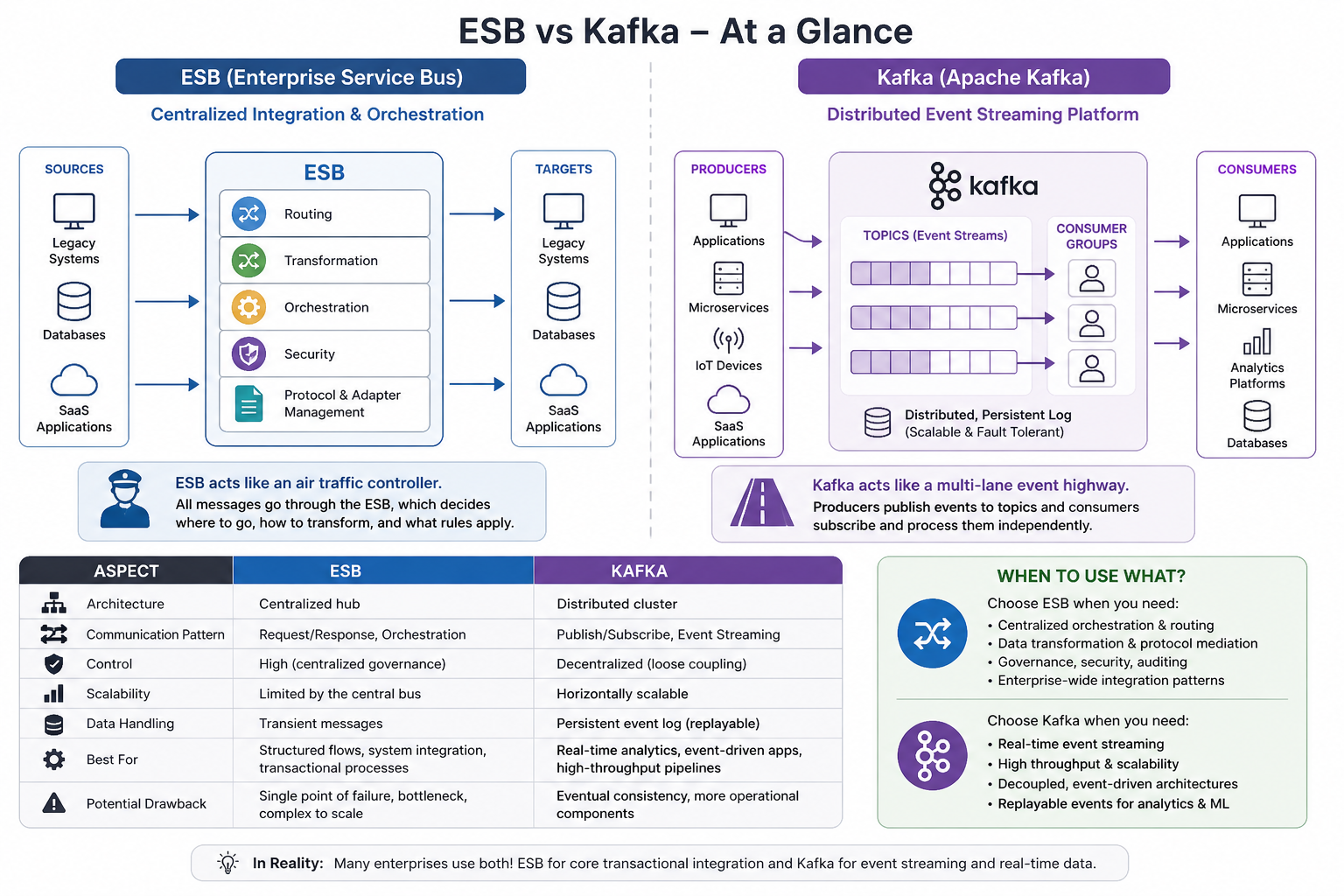

There was a time when ESB and Kafka felt like the same thing—just different ways to move data from point A to point B. Turns out, one is a centralized traffic controller, and the other is a distributed event highway.
ESB: The Central Brain
An Enterprise Service Bus (ESB) comes from the era of Service-Oriented Architecture (SOA).
It acts as a central hub that:
- Routes messages between systems
- Transforms data formats (XML ↔ JSON, etc.)
- Applies business rules and orchestration
- Enforces governance and security
Think of ESB as an air traffic controller. Every request goes through it, and it decides:
- Where the message should go
- How it should be transformed
- What rules should apply
This works well in environments where:
- Flows are structured and predictable
- Centralized control is important
- Integration logic needs to be tightly managed
But that centralization comes at a cost. As systems scale, the ESB can become:
- A bottleneck
- A single point of failure
- A place where too much logic accumulates (“God object” problem)
Kafka: The Event Backbone
Then comes Apache Kafka, built for a different world—real-time, distributed, and scalable systems.
Kafka is not a “bus” in the traditional sense. It’s an event streaming platform.
Instead of sending direct messages:
- Producers publish events
- Consumers subscribe to events
- Data is stored as a log of events (immutable and replayable)
Think of Kafka as a shared event highway:
- No central controller deciding everything
- Systems move independently
- Data flows continuously
This shines in scenarios like:
- Real-time analytics
- Event-driven microservices
- High-throughput data pipelines
Kafka embraces Event-Driven Architecture, where systems react to events rather than wait for instructions.
The Core Difference: Control vs Flow
At the heart of it, the difference isn’t just technology—it’s philosophy.
| Aspect | ESB | Kafka |
|---|---|---|
| Architecture | Centralized | Distributed |
| Pattern | Request/Response, Orchestration | Publish/Subscribe, Event Streaming |
| Control | High (central governance) | Decentralized |
| Scalability | Limited by central hub | Horizontally scalable |
| Data Handling | Transient messages | Persistent event log |
| Coupling | Tighter | Looser |
A Practical Way to Look at It
If you’re designing integration today, the question isn’t:
“ESB or Kafka?”
It’s:
- Do I need central orchestration and transformation? → ESB
- Do I need real-time event streaming at scale? → Kafka
In reality, many enterprises run both:
- ESB for core transactional flows (e.g., banking, compliance)
- Kafka for event streaming and analytics
The Evolution of Integration Thinking
The journey from ESB to Kafka mirrors the industry’s shift:
- From monolithic control → to distributed autonomy
- From synchronous calls → to asynchronous events
- From integration as a layer → to integration as a fabric
And this is where modern approaches like API-led connectivity and event-driven design start to converge.