
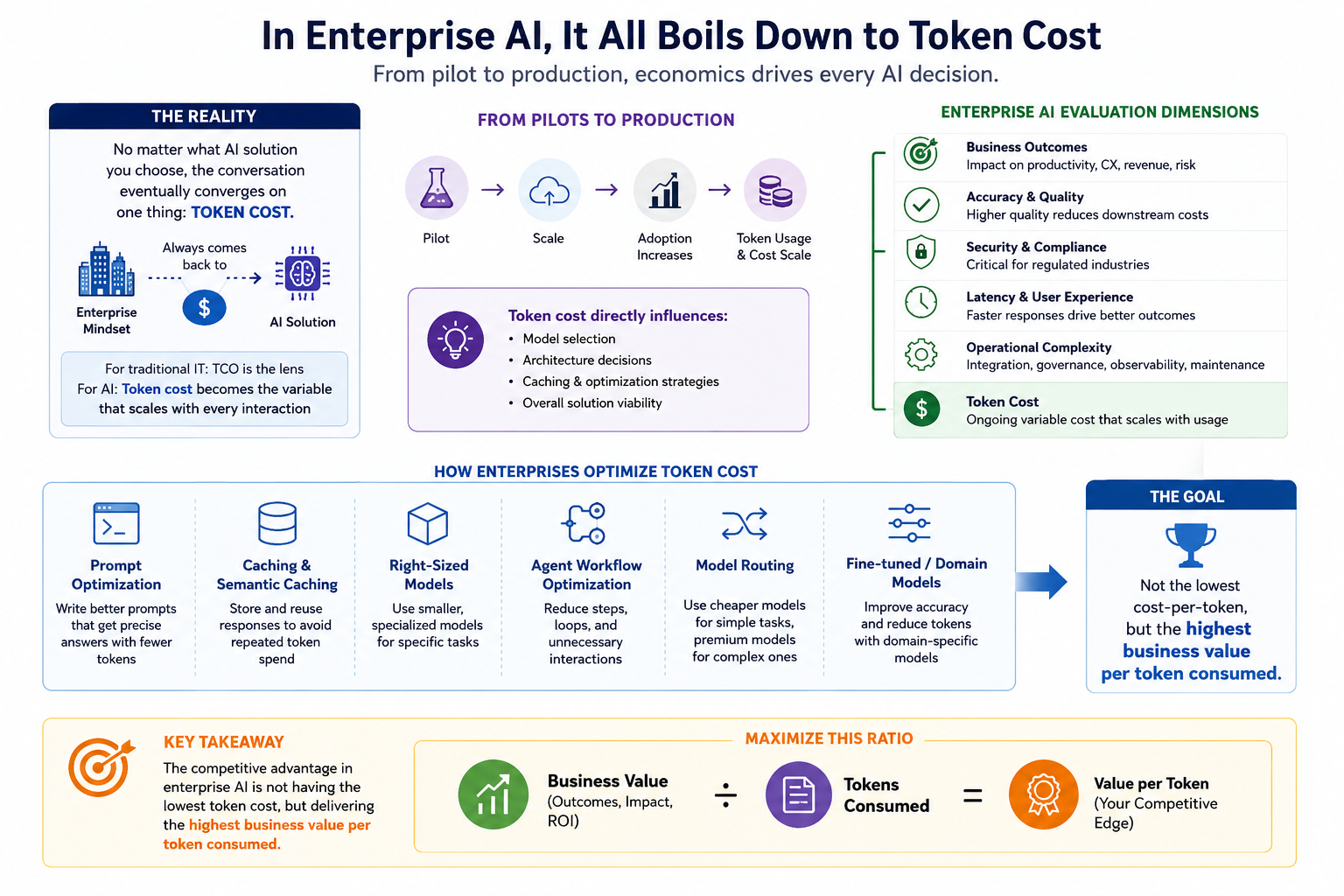
Regardless of the AI platform, model, or architecture selected, enterprise discussions eventually converge on economics. Traditional technology investments have always been evaluated based on total cost of ownership (TCO), implementation effort, operational overhead, and business value. With AI, however, token consumption introduces a new variable cost model that directly scales with usage. As organizations move from pilot projects to production deployments, token cost often becomes a key factor in determining solution viability, influencing model selection, architecture decisions, caching strategies, and overall adoption at scale.
That said, token cost alone is rarely the ultimate competitive advantage. In mature enterprise environments, organizations typically evaluate AI solutions across several dimensions:
- Business Outcomes – Does the AI improve productivity, customer experience, revenue, or risk management?
- Accuracy and Quality – A cheaper model that produces lower-quality results can generate higher downstream operational costs.
- Security and Compliance – Especially in banking, healthcare, and regulated industries.
- Latency and User Experience – Faster responses can be more valuable than lower token costs.
- Operational Complexity – Integration, governance, observability, and maintenance costs.
- Token Cost – The ongoing variable cost that scales with adoption.
What is changing with AI is that infrastructure costs are no longer the dominant operating expense. In traditional applications, compute, storage, and networking drove costs. In AI applications, the LLM itself becomes a metered service where every interaction has a measurable cost.
This is why many enterprises are now focusing on:
- Prompt optimization
- Caching and semantic caching
- Smaller specialized models
- Agent workflow optimization
- Model routing (using cheaper models for simple tasks and premium models only when necessary)
- Fine-tuned or domain-specific models
In fact, some of the most successful enterprise AI implementations are not those using the most powerful model, but those achieving the best cost-per-successful-outcome rather than the lowest cost-per-token.
A useful executive statement is:
The competitive advantage in enterprise AI is not having the lowest token cost, but delivering the highest business value per token consumed.
As AI matures, token pricing will likely become increasingly commoditized, similar to cloud compute and storage. The longer-term differentiators may shift toward model performance, enterprise governance, agent orchestration, observability, and ecosystem integration. Today, though, token cost remains one of the first numbers that enterprises scrutinize when evaluating AI at scale.